
The architecture of possibility: Designing for people, place and purpose
How Article 25’s projects respond to local challenges, improve everyday experiences and create lasting possibility for communities.
What makes architecture meaningful? Is it the buildings we create, the challenges we overcome, or the possibilities those buildings open up?
On 24 October, the world marks UN Day. It is also the origin of our name. Article 25 of the Universal Declaration of Human Rights recognises that everyone has the right to a standard of living adequate for their health and wellbeing, including housing and medical care. That principle has guided our work for 20 years, and it is why we believe the answer lies in all three.
Across our projects, architecture begins with understanding people, place and purpose: translating complex challenges into thoughtful, sustainable spaces that respond to the communities they serve.
People: Designing for everyday experience
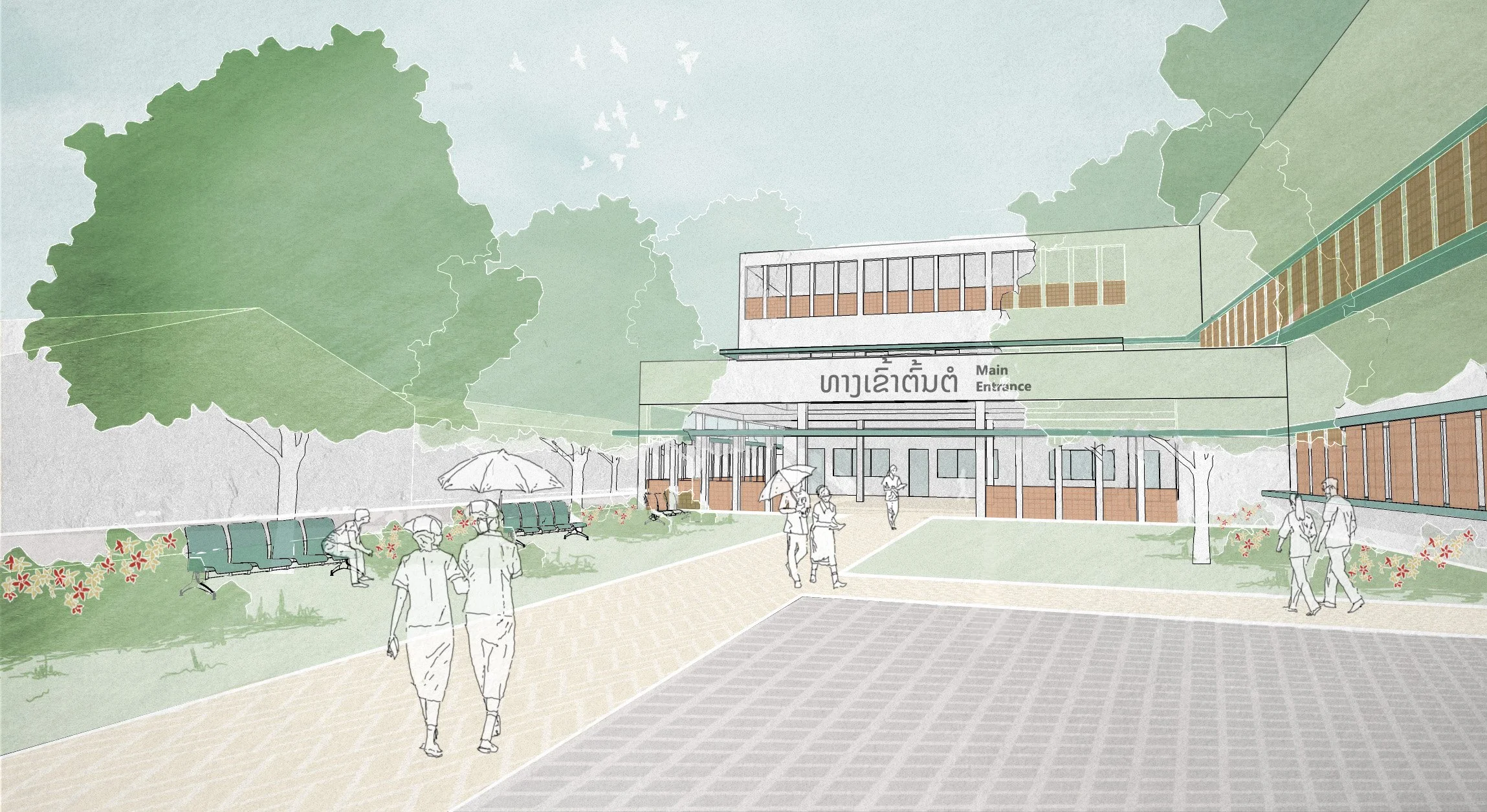
In Laos, Article 25 is designing a phased masterplan and a new Acute Care Building to support the transformation of Khammouane Provincial Hospital.
The hospital, in Thakhek on the banks of the Mekong, has served its community for over a hundred years. That history has left a campus of more than 30 buildings of very variable quality, with a fragmented layout that makes navigation difficult for patients and staff alike.
The new three-storey, approximately 7,000 sqm Acute Care Building will bring essential services, including emergency care, operating theatres, intensive care and outpatient departments, into a more coordinated environment. It is the first of four phases, designed so the hospital can keep operating throughout construction.
Behind these spaces are decisions that directly influence patients’ and staff experiences: circulation routes, accessible entrances, ventilation, room layouts and the relationship between clinical departments. The design also responds to Laos’ tropical climate, with an east-west orientation, solar shading, planted courtyards and mixed-mode ventilation reducing reliance on mechanical cooling.
Developed through close consultation with healthcare professionals and local partners, and supported by the Health and Nutrition Programme, financed by the Grand Duchy of Luxembourg and jointly implemented by the Ministry of Health and LuxDev, the Luxembourg Development Cooperation Agency, the design demonstrates how thoughtful architecture can make healthcare safer, more accessible and more efficient.
Explore the Khammouane Hospital project
Place: Architecture shaped by its context
In Nepal, the design of a new Mycobacterial Research Laboratory demonstrates how architecture must adapt to changing environmental realities.
For nearly 70 years, Anandaban Hospital has been at the heart of Nepal’s fight against leprosy. Following the devastating landslides of September 2024, The Leprosy Mission secured a safer site in Sunakothi, and Article 25 reworked the laboratory design to suit it.
The revised four-storey, 2,000m² design will sit into a steep, terraced hillside, with carefully organised spaces, resilient construction and locally sourced stone and brick, creating a purpose-built environment for vital research.

In Tanzania, the Kao La Amani Preschool and Primary School offers another example of designing with place.
Working within a limited budget and remote location, Article 25 is incorporating locally quarried volcanic stone, passive cooling, solar power and improved water infrastructure into the school’s development.
The campus is designed to run on off-grid solar energy, a first for a school in the region, and a solar-powered borehole will secure a year-round water supply where municipal water is rationed in the dry season.
These decisions connect environmental responsibility, local skills and practical construction with long-term possibilities for children’s education, another right set out in the Universal Declaration of Human Rights.

Discover the Nepal laboratory | Explore Kao La Amani School
Purpose: Beyond the building
A hospital is more than a collection of clinical rooms. A laboratory is more than a research facility. A school is more than its classrooms.
Each represents a possibility: to improve healthcare, advance research, support education and strengthen communities.
Our architects describe Article 25 through words such as purposeful, collaborative, resourceful, sustainable and hopeful. These values become meaningful when translated into buildings that people can use, depend upon and take pride in.
This UN Day, we are reminded that rights only become real when they are built. The architecture of possibility begins by listening to people, understanding places and designing with purpose.
With more than 100 projects in 35 countries, Article 25 designs buildings and infrastructure for communities affected by disaster and poverty around the world.
Discover our projects and learn how you can support Article 25 in building better futures. To discuss support with your next building project in a challenging environment, get in touch: projects@article-25.org
Possibility, built.
🔹With thanks to Article 25’s Architectural Assistants, Congying Luo, Nabiha Warsame and Ecem Gidergi, for contributing their project insights to this article.
