
🔹Written by Article 25’s Architectural Assistant, Yamon Kyaw, this piece forms part of our ‘Voices from NextGen’ series, sharing insights from the next generation of built environment professionals.
Give an architect an ambitious design brief, and somehow we'll manage to fit biodiversity, community engagement, sustainable transport and a café into one project. Now imagine putting all of that on a bridge.
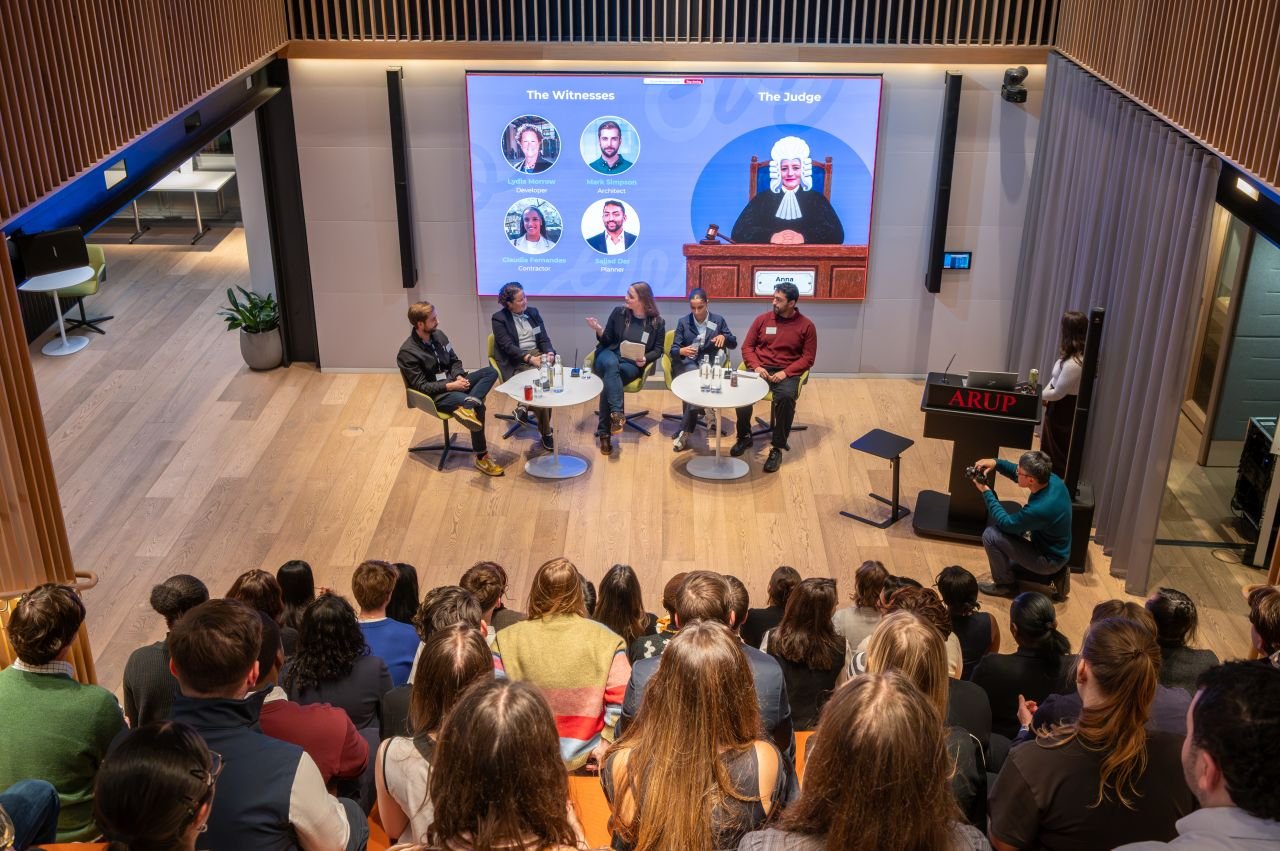
That was essentially the starting point of Article 25's final NextGen event of 2026, Library of the Unbuilt, hosted by Arup.
Our fictional proposal for the evening, The Living Line, was a 1.8km elevated park connecting London Docklands and Greenwich Peninsula. Think woodland gardens, cycling routes, community spaces and beautiful views across the Thames. The presentation boards made a pretty convincing case.
The evening took on a slightly different format from a typical panel discussion. We had a jury, four expert 'witnesses' from different areas of the built environment, and us, the public. Anna Helliar, an Architect at Arup and one of the Co-Founders of the Article 25 NextGen Board, helped guide the discussion, putting some rather challenging questions to our panellists.
Before hearing their arguments, we were asked to take out our phones and vote: should this project be built?
The majority said yes. Remember that for later.
Everyone loves a good concept until someone asks about the budget
One of my favourite questions of the evening was directed at Claudia Fernandes, an Assistant Construction Manager at Overbury: do contractors protect projects from failure, or do they prevent bold ideas from happening?
Those of us from an architectural background all know the stereotype of contractors telling us something is too expensive or impossible to build. But Claudia challenged this, explaining how involving contractors earlier allows them to identify risks and suggest alternatives while there is still room to make changes. For The Living Line, modular construction and prefabrication could reduce the amount of work required on site, particularly when building above a river and operational railway tracks.
She also made an important point: a project isn't successful simply because we manage to build it. It needs to continue working long after the construction team has left.
Then came a slightly painful question for Mark Simpson, a Senior Architect at Arup: if £50 million were removed from the budget tomorrow, what would you cut?
His answer? Remove the non-essential elements, stop the greenwashing and reduce complexity.
Mark compared the cancelled Garden Bridge with the Millennium Bridge, describing the latter's refined system of cables as almost resembling a musical instrument. He questioned our tendency as architects to expect large projects to do everything. The Millennium Bridge doesn't try to be a public square or a garden. It can just be a bridge, and there's absolutely nothing wrong with that.
From a planning perspective, Sajjad Dar, a Senior Town Planning Consultant at Newmark UK, introduced a whole new set of challenges: tidal impacts, aquatic habitats, river navigation, height restrictions near London City Airport, strategic views from Greenwich Park and coordination between two boroughs.
Suddenly, there was quite a lot happening beyond those competition boards.
Lydia Morrow, a Project Director at Lipton Rogers, brought in the developer's perspective. Her example of public viewing galleries in buildings like 22 Bishopsgate was particularly interesting. These galleries occupy some of the most commercially valuable floors, yet are offered to the public for free. The lost rental income still needs to be accounted for. And if every neighbouring tower has a viewing gallery, are we eventually just going to end up looking at each other?
A fair question, actually.
Infrastructure is someone's Monday morning commute
One of the jury members raised a point that stayed with me. We had been discussing railway infrastructure mainly as a construction challenge, but that railway is someone's daily journey to work or school.
Claudia discussed phased construction and communication with affected communities, while Lydia brought up the Elizabeth line. Would it ever have been built if London hadn't been prepared to accept years of disruption in exchange for long-term benefits?
As someone who regularly benefits from the Elizabeth line myself, I could see her point. But moving a few dates around on an Excel spreadsheet and living next to a construction site for several years are two very different experiences.
The audience also questioned whether the ecological benefits of The Living Line would justify the embodied carbon involved in constructing it. While Sajjad explained how environmental impacts would be assessed through planning, Lydia argued that these needed to be weighed against the project's wider benefits.
Mark suggested that investing in London's existing green spaces might be a better use of the money, particularly in boroughs with less funding.
However, an audience member working in local authority green space management offered another perspective. The bridge could connect habitats as well as people. Meadows and woodland offer something quite different from the regularly cut grass found in many urban parks. She also suggested that community partnerships and volunteering could help maintain these spaces.
I hadn't really considered that side of the proposal when first looking at the boards.
Would you walk across The Living Line at 10pm?
Having previously researched women's safety in public spaces during my architecture degree, I was particularly interested in this discussion.
Claudia suggested restricted opening hours, CCTV and security personnel as possible ways of addressing safety concerns. But if the bridge closes at night, aren't we losing one of its main benefits: connectivity?
Similarly, removing dense vegetation to improve visibility could compromise the biodiversity we were trying to introduce in the first place.
I found myself going back and forth on this one. As much as I liked the idea of an elevated garden, would I feel comfortable walking through it alone after dark? And would I still find it useful if it closed before I needed to use it?
There wasn't an easy answer.
So, are we building it?
Out came our phones again. This time, we had three options: build it, redesign it or kill it.
The majority voted to redesign.
Suggestions included shortening the bridge, avoiding construction over railway tracks and creating smaller interventions across the two boroughs. Mark even suggested starting with the most structurally efficient connection a bridge engineer could propose before adding everything else.
What I really enjoyed about the evening was how one fictional project got us talking about everything from railway clearances and commercial rental values to community gardening and women's safety.
As an Architectural Assistant, I spend a lot of time working out how to make a design work. It was refreshing to spend an evening questioning the design itself, especially without an actual project deadline.
I still like the ambitions behind The Living Line. Greener neighbourhoods, better connections and more accessible public spaces? Absolutely. Whether we need a 1.8km garden bridge to achieve them is another question.
Luckily, nobody has submitted a planning application yet.
A big thank you to our four panellists, everyone who contributed to the discussion, the NextGen Board for organising such an enjoyable evening, and Arup for hosting us!
Interested in attending our upcoming NextGen events?
Find out more about the event series open to all members of More Than a Building. Get in touch: nextgen-board@article-25.org.
