
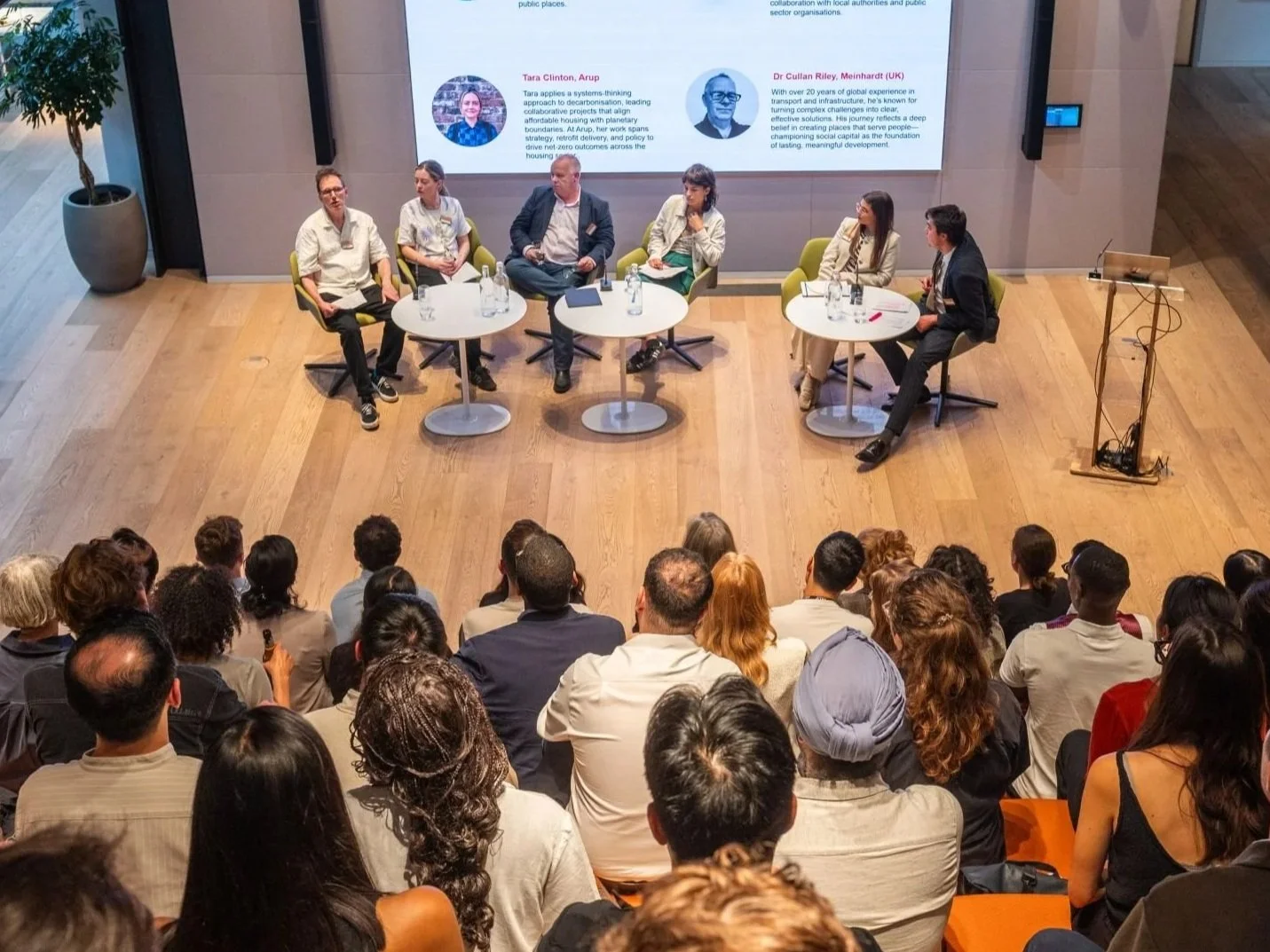
The latest event in the Article 25 NextGen series was a thought-provoking evening that explored the role of the built environment in shaping a fairer, more sustainable society.
Part of the More Than a Building network, the NextGen event series has been designed to connect and inspire rising professionals aged 25 to 35 across architecture, engineering, planning, and beyond.
Hosted by Arup, the evening discussion centred on the theme: How does the future of the built environment affect the future of our society?
The conversation examined how architecture and urban design can address social inequalities - from housing affordability and access to green space, to community cohesion and climate resilience.
The evening featured:
A case study and presentation on key Article 25 projects by Director of Projects, Bea Sennewald.
A panel discussion with leading voices in architecture, engineering, urban design, and humanitarian development. See their bios below.
Drinks, food, and networking shared among young professionals and industry leaders.
Whether participants work on the front lines of planning and design or aim to create deeper impact through their work, the event offered fresh insight, practical inspiration, and meaningful new connections.
Panel speaker bios
Bea Sennewald, Director of Projects, Article 25
Bea leads Article 25’s global portfolio of architecture and construction projects in health, education and housing. With extensive field experience across Africa, Asia, and the Middle East, Bea specialises in designing and delivering socially responsive architecture in some of the world’s most challenging contexts. Bea is a passionate advocate for participatory design and sustainable construction practices that prioritise community resilience and wellbeing.
Tara Clinton, Associate | Public Practice Alumni, Arup
Tara brings a systems-thinking approach to decarbonisation, leading multidisciplinary teams to deliver impactful, multi-stakeholder projects. At Arup, she is managing the delivery of Homes That Don’t Cost the Earth, a collaborative initiative exploring how affordable housing can align with planetary boundaries. Her work spans decarbonisation strategies for residential portfolios, advancing retrofit delivery with the National Retrofit Hub, and shaping net-zero social housing policy for Shelter.
Sean Macintosh, Senior Architect, Arup
A senior architect at Arup since 1997, Sean is passionate about community-driven design. His work includes projects such as Dalston Lane South—a vibrant mixed-use development in East London—and the Druk White Lotus School in Ladakh, blending sustainability with education. Beyond practice, Sean has led campaigns to protect public assets like Brixton Recreation Centre and Leigham Court Road Sheltered Housing, championing the right to inclusive, accessible spaces. His approach centres on environmental responsibility and meaningful social impact.
Silvia Commisso, Urban Designer, We Made That
Silvia is an experienced architect and urban designer with over eight years of professional practice. She is passionate about the relationship between cities and the communities who shape them, celebrating each place’s identity through inclusive, place-based design. At We Made That, Silvia leads urban regeneration strategies in collaboration with local authorities and the public sector. Previously, she worked at Weston Williamson + Partners, focusing on transport-led placemaking in the UK and internationally.
Named Best Young Woman Architect at the 2020 Women in Construction and Engineering Awards and a 2025 graduate of the Future of London Leaders programme, Silvia brings a global perspective and strong social lens to every project.
Dr Cullan Riley, Director, Meinhardt (UK) Ltd
Dr Cullan Riley’s three-decade career spans rewilding initiatives in rural Scotland to leading visionary urban developments abroad. Drawing on deep experience in infrastructure and planning, his focus today is on how the built environment can generate not just economic value, but also strengthen human, environmental, and critically, social capital.
He challenges the industry to move beyond conventional models of capital growth and to build cities and systems that nurture equity, connection, and cultural integrity.
We look forward to welcoming you. Together, let’s shape the next generation of the built environment — one that is not just sustainable, but socially transformative.
See the launch event highlights reel from March 2025 for a flavour of what’s to come.